Which Metal Is Highly Resistant To Corrosion By Sea Water
The marine environment serves as the "ultimate proving ground" for metallic materials. High concentrations of chloride ions, dissolved oxygen, and salts in seawater—combined with tidal action and marine biofouling—subject metals to multifaceted corrosion; ordinary steels can develop rust, perforations, and structural damage within a short period. In applications such as shipbuilding, offshore platforms, seawater piping, and coastal equipment, the choice of seawater-resistant metal directly determines the equipment's service life and maintenance costs.
Among the metal materials commonly used in marine operations, aluminum alloys, 90/10 copper-nickel alloys, and stainless steels are the three mainstream choices. These materials differ significantly in their resistance to seawater corrosion, and each is suited to specific applications.
I. Marine-grade Aluminum Alloys
Marine-grade aluminum alloys (primarily specialized grades such as 5083) are the preferred choice for lightweight ship design. Their core advantages include low density, cost-effectiveness, and excellent formability, enabling reduced hull weight and extended operational range.
Their corrosion resistance stems primarily from inherent self-passivation properties; upon contact with air and seawater, a dense aluminum oxide film rapidly forms on the surface, providing an initial barrier against corrosive agents and resisting atmospheric and mild seawater erosion.
However, their limitations regarding seawater corrosion resistance are pronounced. High concentrations of chloride ions in seawater can easily breach the alloy's passivation film, triggering severe pitting and crevice corrosion. Corrosion rates accelerate significantly in critical marine environments characterized by continuous seawater immersion, tidal action, and wet-dry cycling. Even with specialized processing optimizations, marine aluminum alloys cannot achieve long-term corrosion resistance through material properties alone; they require supplementary protective measures—such as anodizing, anti-corrosion coatings, and cathodic protection—to remain viable for use.
In summary, marine aluminum alloys are unsuitable for demanding applications involving deep-sea immersion or seawater transport piping. They are best suited for lightweight applications subject to mild corrosion, such as non-submerged hull sections, lightweight coastal supports, and deck accessories.
II. Marine-Grade Stainless Steel
Marine-grade stainless steel is widely recognized for its corrosion resistance. Thanks to the passivation film formed by its chromium-nickel alloy composition, the ASME stainless steel offers excellent corrosion resistance and structural strength in fresh water, atmospheric conditions, and dry environments. Due to its high hardness and resistance to deformation, it is often mistakenly viewed as a universal marine anti-corrosion material and is widely used for basic ship fittings.
However, the drawbacks of marine-grade stainless steel become glaringly apparent in high-salinity seawater environments. Its passivation film offers poor resistance to chloride ions; in areas with slow seawater flow, welded joints, or sediment accumulation, chloride ions readily concentrate and penetrate the film, causing localized pitting corrosion. Empirical data shows that the annual corrosion rate of 316L marine stainless steel in seawater can reach 0.1–0.3 mm. Prolonged immersion makes it highly susceptible to pitting, crevice corrosion, and even stress corrosion cracking, leading to issues such as pipeline leaks and component perforations within just a few years.
Even the upgraded 904L stainless steel, which offers improved resistance to seawater corrosion, is suitable only for shallow-water applications or intermittent seawater contact. Long-term, full-immersion use requires frequent application of anti-corrosion coatings and regular maintenance, resulting in high long-term operational costs. Consequently, marine-grade stainless steel is suitable only for dry-deck fittings or non-submerged platform structures; it should absolutely not be used for seawater cooling pipelines or critical submerged components in deep-sea environments.
III. 90/10 Copper-Nickel Alloy
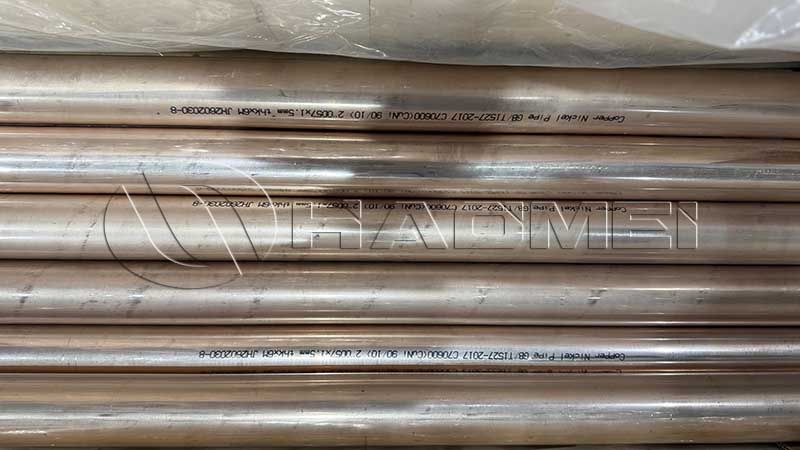
90/10 copper-nickel alloy (90% copper and 10% nickel, commonly known in the marine industry as cupronickel) is a specialized alloy developed specifically for highly corrosive marine environments. Among the three materials discussed, it offers the best overall suitability for marine applications and superior resistance to seawater corrosion. It has long dominated critical, heavy-duty applications such as marine seawater piping systems, heat exchangers for offshore platforms, and water transport equipment for coastal power plants.
It possesses a unique, self-healing anti-corrosion mechanism adapted for seawater—a core advantage that aluminum alloys and stainless steels cannot match. Upon prolonged exposure to seawater, a highly stable protective film of copper-nickel oxide—characterized by exceptional adhesion—spontaneously forms on the alloy's surface, effectively shielding the material from corrosive attacks by chloride ions and dissolved oxygen. Even if this protective film is eroded by high-velocity seawater or abraded by sediment, it can rapidly self-repair within 24 hours, ensuring continuous protection of the substrate against corrosion.
Corrosion data indicates that the annual corrosion rate of 90/10 copper nickel pipes in seawater is less than 0.025 mm—categorized as "minimal corrosion." This performance far surpasses that of 316L and 904L marine-grade stainless steels, completely avoiding common marine corrosion issues such as pitting, crevice corrosion, and stress corrosion cracking. Furthermore, the alloy possesses inherent resistance to marine biofouling, effectively inhibiting the growth of algae, barnacles, and microorganisms. This reduces pipeline blockages and equipment wear caused by bio-corrosion, significantly lowers maintenance frequency, and results in a service life three to five times longer than that of marine-grade stainless steel.
Its only drawback is a higher initial material cost compared to the other two materials; however, thanks to its exceptionally long service life and minimal operation and maintenance costs, it offers far superior overall cost-effectiveness for long-term, heavy-duty marine applications.
IV. Summary of Core Performance and Material Selection for the Three Marine Metals
When evaluating the three materials across four key dimensions—corrosion resistance, suitability for marine conditions, service life, and maintenance costs—distinct performance tiers emerge:
Top 1 (Ultimate Corrosion Resistance): 90/10 Copper-Nickel Alloy. It features self-repairing corrosion protection, resistance to seawater erosion and biofouling, and immunity to localized corrosion risks. Suitable for all seawater-exposed conditions, it is the premier choice for critical marine components subject to high pressure, full immersion, or constant water flow.
Top 2 (Moderate Corrosion Resistance): Marine-Grade Aluminum Alloy. It offers significant advantages in terms of lightweighting and low cost but possesses weak resistance to seawater corrosion. It is suitable only for non-immersed, lightweight auxiliary components exposed to mild corrosive conditions and relies on supplementary anti-corrosion treatments.
Top 3 (Limited Application): Marine-Grade Stainless Steel. It offers adequate standard corrosion resistance but fails to withstand high-salinity chloride ion attack; prolonged immersion in seawater leads to failure. It is suitable only for dry marine structures or auxiliary components with intermittent seawater contact.
Original source: https://www.marinesteelpipe.com/a/which-metal-is-highly-resistant-to-corrosion-by-sea-water.html
Prev: What Is the Best Seawater Pipe Material for Ships
Next: SS Steel Pipe
Related Product
The marine environment serves as the "ultimate proving ground" for metallic materials. High concentrations of chloride ions, dissolved oxygen, and salts in seawater—combined with tidal action and marine biofouling—subject metals to multifaceted corrosion; ordinary steels can develop rust, perforations, and structural damage within a short period. In applications such as shipbuilding, offshore platforms, seawater piping, and coastal equipment, the choice of seawater-resistant metal directly determines the equipment's service life and maintenance costs.
Among the metal materials commonly used in marine operations, aluminum alloys, 90/10 copper-nickel alloys, and stainless steels are the three mainstream choices. These materials differ significantly in their resistance to seawater corrosion, and each is suited to specific applications.
I. Marine-grade Aluminum Alloys
Marine-grade aluminum alloys (primarily specialized grades such as 5083) are the preferred choice for lightweight ship design. Their core advantages include low density, cost-effectiveness, and excellent formability, enabling reduced hull weight and extended operational range.
Their corrosion resistance stems primarily from inherent self-passivation properties; upon contact with air and seawater, a dense aluminum oxide film rapidly forms on the surface, providing an initial barrier against corrosive agents and resisting atmospheric and mild seawater erosion.
However, their limitations regarding seawater corrosion resistance are pronounced. High concentrations of chloride ions in seawater can easily breach the alloy's passivation film, triggering severe pitting and crevice corrosion. Corrosion rates accelerate significantly in critical marine environments characterized by continuous seawater immersion, tidal action, and wet-dry cycling. Even with specialized processing optimizations, marine aluminum alloys cannot achieve long-term corrosion resistance through material properties alone; they require supplementary protective measures—such as anodizing, anti-corrosion coatings, and cathodic protection—to remain viable for use.
In summary, marine aluminum alloys are unsuitable for demanding applications involving deep-sea immersion or seawater transport piping. They are best suited for lightweight applications subject to mild corrosion, such as non-submerged hull sections, lightweight coastal supports, and deck accessories.
II. Marine-Grade Stainless Steel
Marine-grade stainless steel is widely recognized for its corrosion resistance. Thanks to the passivation film formed by its chromium-nickel alloy composition, the ASME stainless steel offers excellent corrosion resistance and structural strength in fresh water, atmospheric conditions, and dry environments. Due to its high hardness and resistance to deformation, it is often mistakenly viewed as a universal marine anti-corrosion material and is widely used for basic ship fittings.
However, the drawbacks of marine-grade stainless steel become glaringly apparent in high-salinity seawater environments. Its passivation film offers poor resistance to chloride ions; in areas with slow seawater flow, welded joints, or sediment accumulation, chloride ions readily concentrate and penetrate the film, causing localized pitting corrosion. Empirical data shows that the annual corrosion rate of 316L marine stainless steel in seawater can reach 0.1–0.3 mm. Prolonged immersion makes it highly susceptible to pitting, crevice corrosion, and even stress corrosion cracking, leading to issues such as pipeline leaks and component perforations within just a few years.
Even the upgraded 904L stainless steel, which offers improved resistance to seawater corrosion, is suitable only for shallow-water applications or intermittent seawater contact. Long-term, full-immersion use requires frequent application of anti-corrosion coatings and regular maintenance, resulting in high long-term operational costs. Consequently, marine-grade stainless steel is suitable only for dry-deck fittings or non-submerged platform structures; it should absolutely not be used for seawater cooling pipelines or critical submerged components in deep-sea environments.
III. 90/10 Copper-Nickel Alloy
90/10 copper-nickel alloy (90% copper and 10% nickel, commonly known in the marine industry as cupronickel) is a specialized alloy developed specifically for highly corrosive marine environments. Among the three materials discussed, it offers the best overall suitability for marine applications and superior resistance to seawater corrosion. It has long dominated critical, heavy-duty applications such as marine seawater piping systems, heat exchangers for offshore platforms, and water transport equipment for coastal power plants.
It possesses a unique, self-healing anti-corrosion mechanism adapted for seawater—a core advantage that aluminum alloys and stainless steels cannot match. Upon prolonged exposure to seawater, a highly stable protective film of copper-nickel oxide—characterized by exceptional adhesion—spontaneously forms on the alloy's surface, effectively shielding the material from corrosive attacks by chloride ions and dissolved oxygen. Even if this protective film is eroded by high-velocity seawater or abraded by sediment, it can rapidly self-repair within 24 hours, ensuring continuous protection of the substrate against corrosion.
Corrosion data indicates that the annual corrosion rate of 90/10 copper nickel pipes in seawater is less than 0.025 mm—categorized as "minimal corrosion." This performance far surpasses that of 316L and 904L marine-grade stainless steels, completely avoiding common marine corrosion issues such as pitting, crevice corrosion, and stress corrosion cracking. Furthermore, the alloy possesses inherent resistance to marine biofouling, effectively inhibiting the growth of algae, barnacles, and microorganisms. This reduces pipeline blockages and equipment wear caused by bio-corrosion, significantly lowers maintenance frequency, and results in a service life three to five times longer than that of marine-grade stainless steel.
Its only drawback is a higher initial material cost compared to the other two materials; however, thanks to its exceptionally long service life and minimal operation and maintenance costs, it offers far superior overall cost-effectiveness for long-term, heavy-duty marine applications.
IV. Summary of Core Performance and Material Selection for the Three Marine Metals
When evaluating the three materials across four key dimensions—corrosion resistance, suitability for marine conditions, service life, and maintenance costs—distinct performance tiers emerge:
Top 1 (Ultimate Corrosion Resistance): 90/10 Copper-Nickel Alloy. It features self-repairing corrosion protection, resistance to seawater erosion and biofouling, and immunity to localized corrosion risks. Suitable for all seawater-exposed conditions, it is the premier choice for critical marine components subject to high pressure, full immersion, or constant water flow.
Top 2 (Moderate Corrosion Resistance): Marine-Grade Aluminum Alloy. It offers significant advantages in terms of lightweighting and low cost but possesses weak resistance to seawater corrosion. It is suitable only for non-immersed, lightweight auxiliary components exposed to mild corrosive conditions and relies on supplementary anti-corrosion treatments.
Top 3 (Limited Application): Marine-Grade Stainless Steel. It offers adequate standard corrosion resistance but fails to withstand high-salinity chloride ion attack; prolonged immersion in seawater leads to failure. It is suitable only for dry marine structures or auxiliary components with intermittent seawater contact.